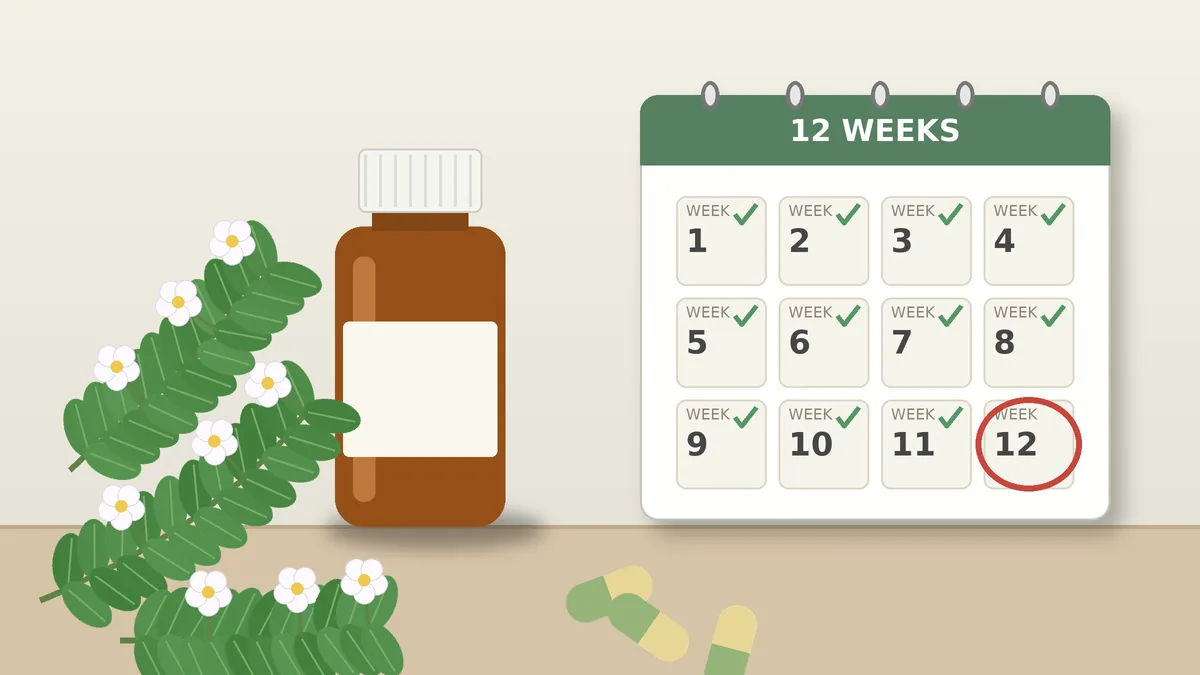
Bacopa monnieri: how long to see results? In most controlled studies, people took a standardized bacopa extract (usually 300 mg a day) for 12 weeks, and that’s when researchers found modest gains, mostly on word-recall memory tests (Pase et al., 2012). One trial found little change at 5 weeks but clearer effects at 12 weeks (Stough et al., 2001), so plan on about three months of daily use before judging it, and expect small changes, not a dramatic boost.
Last updated: November 28, 2026
Bacopa (also called brahmi or water hyssop) is one of the most common herbs in “brain support” supplements. Many people try it for a week or two, feel nothing, and quit. Here’s what the research actually shows about timing, how strong the effects are, and what to check before you start.
What the studies say about timing
Researchers have tested bacopa at several time points. Put together, they show a slow build, not a quick hit.
- After one dose: nothing measurable. In a single-dose study, people were tested 2 hours after taking bacopa extract, and researchers found no difference from placebo (reviewed in Calabrese et al., 2008). The same review notes that 4 weeks of a ginkgo-plus-bacopa combination also didn’t improve thinking in 85 healthy adults.
- Around 5 weeks: little to show. In the Stough trial, 46 healthy adults took 300 mg a day and were tested at 5 and 12 weeks. The biggest effects showed up at 12 weeks (Stough et al., 2001). A later trial team described that result as effects “at 12 weeks but not at 5 weeks,” suggesting bacopa’s effects “may take months to appear” (Calabrese et al., 2008).
- At 6 weeks: a few small signals. In 60 medical students taking 150 mg twice a day for six weeks, bacopa beat placebo on some memory tests but not others (Kumar et al., 2016). The Merck Manual describes this as improvement on “some memory and cognitive function tests, but no difference in other neuropsychological tests” (Merck Manual).
- At 12 weeks: where most positive results show up. A systematic review found that all six qualifying trials lasted 12 weeks, used 300 to 450 mg of extract a day, and improved 9 of 17 free-recall memory tests (Pase et al., 2012).
- After stopping: some effects may linger for weeks. One trial in older adults with age-related memory complaints found no loss of gains 4 weeks after treatment ended (reviewed in Calabrese et al., 2008). Longer-term data are limited.
Bacopa studies at a glance: length, dose, and results
These are the human trials most often cited when people ask how long bacopa takes. All were randomized and placebo-controlled.
| Study | Who took part | Daily dose | Length | What changed vs. placebo |
|---|---|---|---|---|
| Stough et al., 2001 | 46 healthy adults, 18–60 | 300 mg extract | Tested at 5 and 12 weeks | Faster visual processing, better learning rate and memory consolidation, lower anxiety; biggest effects at 12 weeks |
| Roodenrys et al., 2002 | 76 adults, 40–65 | Bacopa extract | 3 months | Better retention of new information; attention, short-term memory, and everyday memory unchanged |
| Calabrese et al., 2008 | 54 adults 65+ (48 finished) | 300 mg standardized extract | 12 weeks | Better delayed word recall and Stroop scores; no change in divided attention, a working-memory test, or mood |
| Morgan & Stevens, 2010 | 98 healthy adults over 55 (81 finished) | 300 mg extract | 12 weeks | Better verbal learning and delayed recall; no significant change on other memory tests or self-rated memory |
| Kumar et al., 2016 | 60 medical students, 19–22 | 150 mg twice a day | 6 weeks | Improvement on some memory tests, not others |
Two patterns stand out. Most trials ran 12 weeks, and most found gains on some memory tests but not all of them. The trials were also small, from a few dozen to about 100 people.
How strong is the evidence?
Honest answer: modest and mixed. Reviews that pool the trials don’t fully agree.
- A 2014 meta-analysis of nine trials (518 people, all lasting at least 12 weeks) found faster attention and reaction times, rather than a clear memory effect (Kongkeaw et al., 2014).
- A 2021 analysis noted that “no two studies found statistically significant changes in the same two tests” in healthy people (Brimson et al., 2021).
- A 2026 review of trials in healthy adults found no overall benefit from bacopa and called its memory effects “inconclusive” (Marsh et al., 2026).
- A 2026 network meta-analysis of 29 bacopa and ginkgo trials found that bacopa beat placebo on some memory measures, with the strongest working-memory results at 600 mg a day or more, but the authors said the lack of direct comparisons may limit the strength of the evidence (Tiemtad et al., 2026).
The Merck Manual’s bottom line is blunt: “There are no high-quality studies demonstrating that bacopa is effective for improving memory or cognitive function or treating any disorder” (Merck Manual). That’s a more careful picture than you’ll find in our older roundup of supplements marketed for memory and focus, which mentions bacopa alongside adrafinil, piracetam, and rhodiola.
How to give bacopa a fair 12-week test
If you and your doctor decide it’s reasonable to try, these steps follow how the studies were run.
- Pick a standardized extract with the dose on the label. The trials used extracts at 300 to 450 mg a day (Pase et al., 2012). A “proprietary blend” that hides the amount can’t be compared with the research.
- Take it every day. The studies tested daily use over weeks, not occasional doses.
- Write down a starting point. Note a few things you struggle with now, like names or where you put your keys, so you have something to compare against later.
- Wait until about week 12 to judge. Judging at week 2 or 3 is earlier than any trial found benefits.
- Stop if side effects bother you, and report serious problems to the FDA through MedWatch.
Checklist: before you start bacopa
- ☐ You’ve talked with your doctor or pharmacist, especially if you take any prescription medicine. The FDA advises talking with a health care professional before taking any supplement (FDA).
- ☐ You don’t take thyroid hormone medicine. The Merck Manual says people who do should not take bacopa.
- ☐ Real memory changes have been checked out. Treatable problems such as depression, medication side effects, or thyroid, liver, or kidney problems can cause memory trouble (NCCIH).
- ☐ The label lists the extract and the amount per capsule.
- ☐ The product doesn’t claim to treat Alzheimer’s or another disease. The FDA has sent warning letters over illegal Alzheimer’s claims, and one product it named was sold as “Bacopa Monnieri” (FDA).
- ☐ You’re not buying because of glowing testimonials. Here’s how to tell when supplement testimonials are fake.
Keep in mind that the FDA doesn’t approve supplements for safety or effectiveness before they’re sold (FDA), and some products sold as supplements have turned up with hidden drugs, as our list of male enhancement pills the FDA flagged in 2026 shows.
Side effects and drug interactions
In the trials, bacopa was generally well tolerated, but stomach problems were the most common complaint.
- Stomach and gut: more frequent stools, abdominal cramps, and nausea (Morgan & Stevens, 2010). In the Calabrese trial, side effects were “primarily stomach upset,” with about the same number of reports in the bacopa and placebo groups.
- Other common effects: gastrointestinal upset, nausea, and dry mouth (Merck Manual). One review also lists muscle fatigue as more common than with placebo in one trial (Roe & Venkataraman, 2021).
The Merck Manual lists these possible drug interactions (Merck Manual):
- Bacopa can raise acetylcholine, so it may weaken anticholinergic drugs or add to the side effects of drugs that raise acetylcholine, such as some glaucoma and Alzheimer’s medicines.
- It may raise thyroid hormone levels.
- It may change blood levels of drugs processed by the liver’s cytochrome P450 enzymes, such as warfarin, some calcium channel blockers, and antiseizure medicines.
Talk to your doctor
Talk to your doctor or pharmacist before trying bacopa, especially if you take any of the medicines above or have a health condition. Don’t let a supplement delay a check-up: the NIH advises against using complementary approaches “as a reason to postpone seeing a health care provider about memory loss” (NCCIH). A doctor can look for treatable causes first and tell you whether bacopa is safe with your other medicines. For more plain-English supplement guides, browse our men’s health section.
FAQ
How long does it take for bacopa monnieri to work?
Most studies measured results after about 12 weeks of daily use, usually 300 mg of standardized extract. One trial saw little at 5 weeks but clearer effects at 12 weeks. A small 6-week study found gains on only some tests.
Can you feel bacopa right away?
Probably not. In a single-dose study, people tested 2 hours after taking bacopa did no better than placebo. Studies that found benefits gave it daily for weeks to months.
Do bacopa’s effects last after you stop taking it?
Possibly for a while. One trial in older adults found no loss of memory gains 4 weeks after a 12-week course ended. Longer-term data are limited.
Does bacopa interact with any medications?
It can. The Merck Manual warns of possible interactions with anticholinergic drugs, some glaucoma and Alzheimer’s medicines, thyroid hormone, and drugs like warfarin, some calcium channel blockers, and antiseizure medicines. Ask your pharmacist before combining them.
Is bacopa monnieri safe?
In trials lasting up to about 12 weeks, it was generally well tolerated. The most common side effects were stomach upset, nausea, cramps, more frequent stools, and dry mouth. People taking thyroid hormone medicine shouldn’t take it, per the Merck Manual.
Sources
- Merck Manual Professional Version. Bacopa (checked Nov. 28, 2026).
- Pase MP, Kean J, Sarris J, et al. The cognitive-enhancing effects of Bacopa monnieri: a systematic review of randomized, controlled human clinical trials. Journal of Alternative and Complementary Medicine. 2012.
- Stough C, et al. The chronic effects of an extract of Bacopa monniera (Brahmi) on cognitive function in healthy human subjects. Psychopharmacology. 2001.
- Roodenrys S, et al. Chronic effects of Brahmi (Bacopa monnieri) on human memory. Neuropsychopharmacology. 2002.
- Calabrese C, Gregory WL, Leo M, et al. Effects of a standardized Bacopa monnieri extract on cognitive performance, anxiety, and depression in the elderly. Journal of Alternative and Complementary Medicine. 2008;14(6):707–713.
- Morgan A, Stevens J. Does Bacopa monnieri improve memory performance in older persons? Journal of Alternative and Complementary Medicine. 2010;16(7):753–759.
- Kumar N, Abichandani LG, Thawani V, et al. Efficacy of standardized extract of Bacopa monnieri (Bacognize) on cognitive functions of medical students: a six-week, randomized placebo-controlled trial. Evidence-Based Complementary and Alternative Medicine. 2016.
- Kongkeaw C, et al. Meta-analysis of randomized controlled trials on cognitive effects of Bacopa monnieri extract. Journal of Ethnopharmacology. 2014.
- Brimson JM, et al. The effectiveness of Bacopa monnieri (Linn.) Wettst. as a nootropic, neuroprotective, or antidepressant supplement: analysis of the available clinical data. Scientific Reports. 2021.
- Marsh A, Quelch D, Mackonochie M, et al. The efficacy of nutritional phytochemical compounds in improving cognition. International Journal of Neuropsychopharmacology. 2026.
- Tiemtad P, et al. Comparative effects of Bacopa monnieri and Ginkgo biloba on cognitive functions: a systematic review and network meta-analysis. Phytomedicine. 2026.
- Roe AL, Venkataraman A. The safety and efficacy of botanicals with nootropic effects. Current Neuropharmacology. 2021.
- National Center for Complementary and Integrative Health (NIH). Alzheimer’s Disease at a Glance.
- U.S. Food and Drug Administration. FDA 101: Dietary Supplements.
- U.S. Food and Drug Administration. Unproven Alzheimer’s Disease Products.
- U.S. Food and Drug Administration. MedWatch: Safety Information and Adverse Event Reporting Program.
This article is general information only, not medical advice. See our medical disclaimer.